Showing posts with label Xi'an. Show all posts

Friday, June 6, 2014

Xi'an and her city walls

Xi'an is the capital of Shaanxi province in CHina and one of the country's oldest cities, with more than 3,100 years of history. The two Chinese characters "西安" in the name Xi'an literally mean "Western Peace".  The city has had a lot of names throughout its history: During the Zhou dynasty (c. 1046–256 BC), the area was called Fenghao; tt was renamed Chang'an, meaning "Perpetual Peace", during the Han dynasty (206 BCE–220 CE);  it changed in 581 CE to Daxing during the Sui dynasty; and back to Chang'an from 618 during the Tang dynasty. During the Yuan dynasty (1270–1368), the city was known as Fengyuan, followed by Anxi, and then Jingzhao. It finally became Xi'an in 1369 at the time of the Ming dynasty. This name remained until 1928, then in 1930 it was renamed Xijing, or "Western Capital". The city's name once again reverted to its Ming-era designation of Xi'an in 1943.

The city itself is one of the "Four Great Ancient Capitals of China", having held the position under several of the most important dynasties in Chinese history, including Zhou, Qin (of Terracotta Warrior fame), Han, Sui, and Tang.


Xi'an is the starting point of the Silk Road, which connected East to West for important spice and silk trade.  Since the 1990s, the city of Xi'an has re-emerged as an important cultural, industrial and educational center of the central-northwest region, with facilities for research and development, national security, engineering universities,  and China's space exploration program. It is now one of the most populous built-up areas in inland China with  more than 8 million people living.  According to a July 2012 report by the Economist Intelligence Unit, it was recently named as one of the 13 emerging megacities in China.

All of this is hard to understand given what we saw: lots and lots of empty, half-constructed apartment buildings emerging from the earth like fingers.  These buildings are in clumps and look like dominoes that you could easily knock over in a line.  It is even more mind-boggling to think that when my brother studied there twenty years, nothing was taller than the famed city walls and the only Western restaurant that he found was a KFC (not at all inappropriate, considering we are from Kentucky).  We called him at one point to hear his recollections of spending a summer here in 1994 and we were dumbfounded at the difference between what we heard and what we saw. 
 

I think that the rapid redevelopment of the area though isn't necessarily a good thing.  The pollution, dirt, construction noise, and traffic creates a place that isn't at all very welcoming.  They are trying to build a metro system, but where we were staying (by a newly built convention center with no restaurants near it save a noodle place and a cafe), and trying to make it tourist friendly, but the city still has a way to go.  However, given the pace of the redevelopment, I am sure that in like 5 years it will be done.

The city walls represent one of the oldest and best preserved Chinese city walls. Construction of the first city wall of Chang'an began in 194 BCE and lasted for four years. That wall measured 13.74 km/8.54 mi in length,  and 12–16 meters/39–52 ft thick at the base. The area within the older walls was roughly 36 sq km/14 sq mi.


The existing wall was started by the Ming Dynasty in 1370. It encompasses a much smaller city of 14 square km/5.4 sq mi.  The wall measures 13.7 km/8.5 mi in distance around this area, and are about 12 m/39 ft high, and 15–18 m/49–59 ft thick at the base.


In about 370,  Zhu Yuanzhang sent out imperial decree to build Xi'an City and its walls, which were just tamped down dirt. In later dynasties, the walls were expanded, long and taller, and fortified with real stone.  It seems that every dynasty from there on out had to do some major reparations to the wall and its towers. Drainage was added, more bricks to make ramparts. The last major reconstruction occurred in 1781, and that is structure that is presented today.

Another major renovation occurred in 1983, where buildings on the walls were repaired, including the tower were sheep and horses could rest at night (Yangmacheng tower). Jiaolou tower, or the corner tower, was still a bit under construction when we were there, but I think it was recent damage. 


In the same year (1983), broken rampart were changed into gates so you can enter and exit at different points on the gate (though not any more because of ticket booths), and the moat was restored. In May 2005, the Xi'an ramparts were all connected, so you could walk all around the 13 km-- or bike!  There is a bike rental shops at the entry point of the wall (the South Gate)!


Every 120 meters, there is a rampart which extends out from the main wall. All together, there are 98 ramparts, which were built to defend against the enemy climbing up. Each rampart has a sentry building, in which the soldiers could protect the entire wall without exposing themselves to the enemy. And cleverly enough, the distance between every two ramparts is just within the range of an arrow shot from either side, On the outer side of the city wall, there are 5,948 crenelations. The soldiers can outlook and shoot at the enemy but is still protected. On the inner side, parapets were built to protect the soldiers from falling off.

The City Wall has totally 18 city gates, but they are not all open for visitors. We went up the South Gate, but there are many others: Small South Gate, East Gate, West Gate, North Gate, Heping Gate, Wenchang Gate and Hanguang Gate. You can choose the nearest city gate according to your location. 

The circular City Wall Park has been built along the high wall and the deep moat. Trees, flowers, green spaces, and tables strewn throughout the park, it is a popular place for people to gather.  We watched several games of cards and fashion photo shoots from above. 
 

We probably walked probably only half of a side of the rectangular path, which is wide enough to fit 5 chariots across it (maybe more, I can't remember exactly).  The weather wasn't that great and after a while, you get kinda bored looking at the skyscrapers. Though, two towers with the traditional-looking houses on top as the penthouses were pretty cool.


Tuesday, June 3, 2014

Terracotta Warriors of Xi'an

In March, we went back to China--this time to Xi'an.  It was a place that I didn't know much about, other than my brother studied there for a summer at the engineering school in college twenty years.  He was the only white kid there and the only Western food at the time was KFC.   The main reason to go to Xi'an, of course, is the terracotta warriors.  They were discovered in 1974 when a farmer was digging a well during a drought.  Imagine his surprise when he instead discovered an unknown tomb and about 6,000 warriors. 

When my brother was there, it was just a pit and now it is a main tourist site, complete with the stalls for all the souvenir stuff you could imagine.  There are a million tourists there and a million tour guides harassing you to hire them.  We walked to the main building, which housed pit 1, and passed by several carved steps that were reminiscent of the steps at the Forbidden City.

The Chinese tourist industry is trying to dress up the surrounding areas of these pits with wall carvings as well as they build a new museum. 

The warriors are part of the Qin Shi Huang's burial site.  He was the first Emperor of Qin dynasty, and where we get our Western word for China.  He lived about 260-210 BCE and as soon as he ascended to the throne (at age 13, about 246  BCE), he began construction on his mausoleum and all the items and people he would need in the afterlife.  This included his terracotta warriors.
on the wall

walking to the Pit, with a new museum being built behind Will.

 
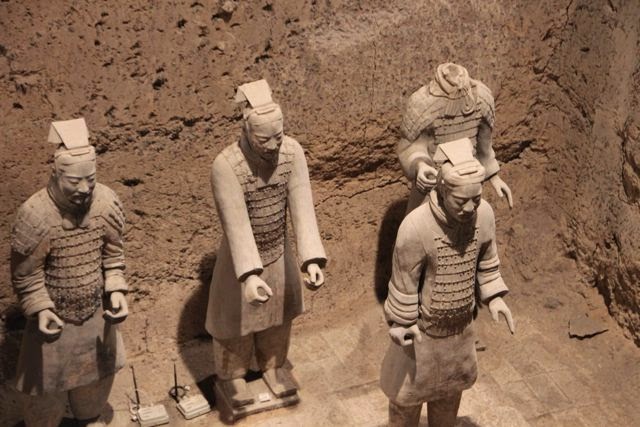
The first pit to be discovered is called Pit 1 and it has 6,000 warriors and several dozen horses.  The warriors are all different: different hands, different top knots in their hair, different uniforms, and different faces.  They are hollow and archeologists and historians think that there was a factory-like set-up in creating them.  The men creating this clay army would mix and match molds to create individual warriors, charioteers, and horses.  Experts think that it probably took about 700,000 mean to create the army, its weapons, and chariots, and the mausoleum (which has yet to be even opened). 


There are three pits on display and current estimates are that in the three pits containing the Terracotta Army there were more than 8,000 soldiers, 130 chariots with 520 horses, and 150 cavalry horses, the majority of which are still buried.  Other terracotta non-military figures have been found in other pits not open to the public yet and they include officials, acrobats, strongmen, and musicians. The figures vary in heights as well; the tallest being generals of course.


The figures were placed in the pits in precise military formation according to rank and duty, and most held real weapons such as spears, swords, or crossbows. Originally, the figures were also painted with bright pigments, variously colored pink, red, green, blue, black, brown, white, and lilac. Most of the original weapons have either rotted away or looted and the paint has faded from the faces.


When my brother was there, there was not a proper structure covering Pit 1, the only one open at the time.  Now, there is a huge hanger-like structure over the pits.  The first section of Pit 1 shows the warriors and horses lined up in formation, facing a gateway, ready to protect the Emperor from evil spirits.   There are 11 corridors that were originally covered by reed mats supported by wooden beams.  Dirt was filled in on top of the soldiers, buried to protect their king. 


Towards the back of the Pit 1, you can watch archeologists are work: inspecting the broken shards of clay, measuring the faces, and reconstructing the warriors and horses. The workers somehow "glue" the pieces together and use saran wrap to hold the pieces in place as it dries.  Once a figure has been put back together, he awaits his turn in being placed back in formation.  It seems as if the archeologists work right on top of still-buried warriors.


Pit 2 has cavalry and infantry units as well as war chariots, that have rotted away. It is thought to represent a military guard. 
pit 2

broken warriors in pit 2
 Pit 3 is the command post, with high-ranking officers and a war chariot.


Pit 3, with the mats on top still


Several figures have been set aside as perfect examples of the warriors.   There is a kneeling spearman, his spear long ago destroyed.

A cavalry man leads his horse with an amazing bronze bridal 


a warrior yet to be reassembled with his body
Attached to the pits is a museum that gives some historical context to Emperor Qin and his accomplishments for China.  He expanded the Great Wall, standardized weights and measures, and divided his empire into administrative units, which allowed it to be better ruled.


Emperor Qin
When he died, his body was placed in a bronze chariot that is 50% smaller than a real chariot and horses.  There are two chariots on display: the first one has a driver who holds an umbrella over two seats and the second one in which his body was hauled. 

They were unearthed in 1980 and are two of the 64 designated historical artifacts that can never leave Chinese soil. 

driver of chariot 1

 The second chariot was discovered in pieces and it took about 5 years to restore.
second chariot

Will reflected in the glass, looking at chariot 2

horses of chariot 1

horses of chariot 2

chariot 2

entry into pit 1

It is truly an awesome site.  The sheer number of these warriors is astonishing and the archeologists haven't really begun excavated the entire burial site.  According to an ancient Chinese historian, the First Emperor was buried with "palaces, towers, officials, valuable artifacts, and wondrous objects." If we are to look at the warriors, I can only imagine what is still buried in the tomb.